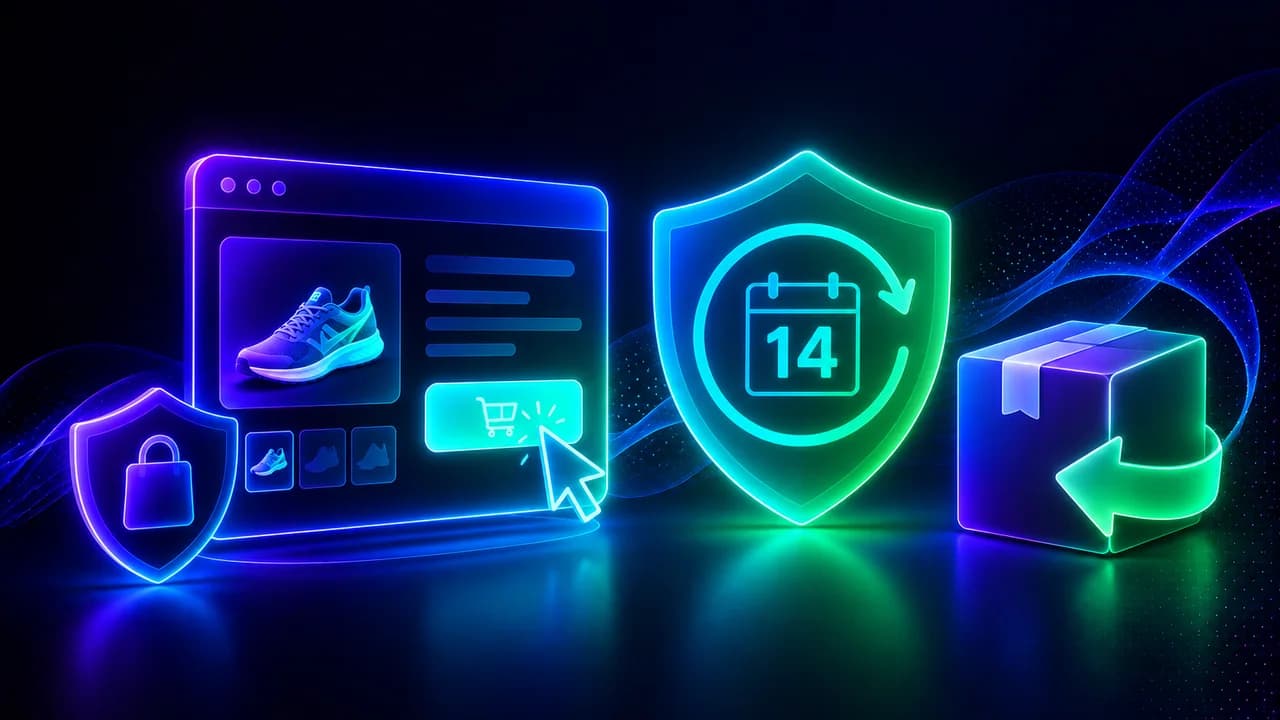
The 14-Day Right of Withdrawal: Communicate the Guarantee Without Hurting Conversion
Turn the EU right of withdrawal into a clear trust signal with visible return terms, simple processes, and sales-page copy that reduces purchase anxiety.
Written by

Share this
Unlock exclusive Atomicat content
Beyond the blog (/blog), browse our free marketing resources and free tools for calculators and templates (/templates). If you came here searching for landing page tips or landing page best practices specifically, start with the pillars above before browsing further. Browse /resources and /tools.
What the right of withdrawal is and why it matters on your sales page
In Spain and throughout the European Union, the right of withdrawal gives online buyers 14 calendar days to return a product without having to justify their decision. This right is established in the General Law for the Protection of Consumers and Users and cannot be waived. You cannot eliminate it, shorten it, or make it conditional. What you can do is communicate it in a way that strengthens buyer confidence instead of creating fear of returns.
The problem many online businesses face is that they perceive the right of withdrawal as a threat. They think that making it visible will lead to more returns. The reality is exactly the opposite. Studies show that a clear, visible returns policy increases the conversion rate because it reduces the perceived risk of the purchase. The customer thinks, 'If I do not like it, I can return it,' and that gives them the confidence to click the buy button.
How to communicate the returns policy to increase sales
The key is to frame the right of withdrawal as a satisfaction guarantee, not as a bureaucratic process. Instead of hiding the returns policy in the terms and conditions, highlight it as a benefit. Use phrases such as '14 days to try it with no commitment' or 'If you are not satisfied, we will refund your money, no questions asked.' This type of language transforms a legal obligation into a commercial advantage.
Place information about online purchase returns at three strategic points on your page: next to the price, beside the buy button, and in a frequently asked questions section. Each of these points is a decision-making moment when the visitor is evaluating whether the risk is worthwhile. Displaying the money-back guarantee at those moments reduces anxiety and encourages conversion.
Tools such as Atomicat allow you to create visually appealing guarantee sections on your sales page. A professionally designed '14-day guarantee' badge beside the buy button can significantly improve your conversion rate. Do not underestimate the power of a well-designed icon to communicate security.
Exceptions to the right of withdrawal that you should know
Not all products and services are subject to the right of withdrawal. The main exceptions include made-to-order personalized products; sealed products that cannot be returned for hygiene reasons once opened; unsealed audio or video recordings; daily newspapers and magazines; and services fully performed, with the consumer's consent, before the withdrawal period ends.
For digital products such as online courses, ebooks, or software, you can exclude the right of withdrawal provided that the consumer has expressly consented to performance beginning during the withdrawal period and acknowledged that they lose their right once performance begins. This consent must be explicit and separate from the general acceptance of the terms and conditions.
If you sell digital products, your returns policy should explain these exceptions clearly and without legal jargon. Wording such as 'By accessing the digital content, you agree that performance will begin and acknowledge that you lose your right of withdrawal' is much easier to understand than a reference to Article 103 of the Consumer Law.
The returns process as a brand experience
When a customer exercises their right of withdrawal, their experience during the online purchase returns process determines whether they will buy from you again in the future. A simple, fast, frictionless returns process turns a dissatisfied customer into an advocate for your brand. A complicated, slow process full of obstacles turns that same customer into a detractor who will leave negative reviews.
Integrating a payment system such as AtomicPay makes returns easier to manage because it allows refunds to be processed automatically and transparently. The customer receives immediate confirmation that their return has been accepted and can track the status of their refund in real time. This transparency reduces support inquiries and improves the perception of your brand.
Consider offering alternatives to a cash refund. Store credit, a product exchange, or a discount on the next purchase can be attractive options that reduce your effective return rate while keeping the customer within your ecosystem. Always offer these alternatives as options, never as obligations, because the right of withdrawal guarantees a refund.
Extending the returns period as a conversion strategy
Although the law requires a minimum of 14 days, nothing prevents you from offering a longer period. Many successful brands offer 30, 60, or even 90 days for returns. Paradoxically, the longer the period, the lower the return rate. This is due to the endowment effect: the longer a customer has a product, the more accustomed they become to it and the less likely they are to return it.
Furthermore, a generous returns period signals confidence in your product. If you offer 90-day returns, buyers assume you must be very confident in the quality of what you sell. This perception reduces purchase anxiety and consistently improves the conversion rate. It is an investment that pays for itself through additional sales.
If you use sales videos on your page through AtomicPlayer, mentioning the money-back guarantee in the video reinforces the message. A presenter who confidently says, 'You have 30 days to try it risk-free,' has more impact than static text at the bottom of the page. The combination of social proof, a money-back guarantee, and persuasive video is a conversion formula that is difficult to beat.
Mandatory information about the right of withdrawal
The law requires you to inform consumers about the right of withdrawal before they complete their purchase. You must provide a model withdrawal form (included in Royal Legislative Decree 1/2007), the conditions, time limit, and procedures for exercising the right, and information about who bears the cost of returning the product.
If you do not provide this information, the withdrawal period is extended to 12 months from the product's delivery date. This means a customer could return a product one year after receiving it if you did not properly inform them of their rights. Complying with the information requirement is not merely good practice; it is essential protection for your business.
Returns and loyalty: an unexpected relationship
Consumer behavior data reveals something counterintuitive: customers who have returned an online purchase and had a positive experience are more loyal to the brand than those who have never returned anything. The reason is that the return acts as a trial by fire for the brand. Customers discover that the guarantee promises are real, that the company responds quickly, and that the process is straightforward. This experience builds deep trust that translates into repeat purchases and recommendations to others.
To take advantage of this effect, treat every return as an opportunity to build loyalty, not as a problem. When a customer contacts you to return a product, respond with empathy, manage the return efficiently, and use the interaction to understand why they are returning it. That information is extremely valuable for improving your product, its description, and your communication. A well-managed returns process can transform a negative experience into a customer for life.
Hidden costs of a restrictive returns policy
Many businesses implement restrictive returns policies because they think these policies save money. What they do not see are the hidden costs: customers who do not buy because the policy makes them distrustful, those who buy but leave negative reviews mentioning how difficult it was to make a return, and those who initiate chargebacks with their bank because they find the internal returns process impossible. Each chargeback costs between 15 and 50 euros in penalties, in addition to the loss of the sale amount.
A generous, transparent returns policy reduces all these hidden costs. Yes, you may have a couple more returns each month. However, the reduction in chargebacks, improvement in reviews, and increase in the conversion rate more than compensate for that marginal increase. The economic calculation favors generosity in returns, not restriction. And the right of withdrawal guarantees that customers can always return their purchase, so the question is not whether to allow returns but how to manage them as intelligently as possible.
How to communicate the right of withdrawal on your sales page
The way you present the returns policy on your sales page can turn it into a sales argument instead of a legal obligation. Rather than hiding the legal text in small print on a secondary page, highlight your money-back guarantee as a prominent visual element beside the buy button. A shield icon with the text '14-day money-back guarantee, no questions asked' conveys confidence at the exact moment when the buyer is deciding whether to spend their money.
Businesses that go beyond the legal minimum of 14 days and offer 30- or even 60-day guarantees send a powerful message: they have so much confidence in their product that they are willing to give you more time than the law requires to try it. Paradoxically, extending the returns period often reduces the return rate because it eliminates the urgency to return quickly. When buyers know they have 60 days, they do not feel pressured to decide within the first 14. By the time day 60 arrives, they have already forgotten about the possibility of returning the product because they are satisfied with their purchase.
Conclusion: returns as a sales tool
The right of withdrawal is not your enemy. It is your most underrated sales ally. A clear, visible, and generous returns policy increases buyer confidence, improves the conversion rate, and reduces purchase anxiety. Instead of hiding online purchase returns in the small print, display the policy prominently beside your buy button. Instead of offering the legal minimum of 14 days, offer more. Your competition is afraid of returns. You are going to use them to sell more.
Published
August 26, 2026
Categories