Landing Page A/B Testing: What to Test First to Raise Conversion
Landing page A/B testing works when you test one high-leverage change first—headline, offer, or proof—and read conversion plus CPA, not vanity metrics.
Written by

Share this
Unlock exclusive Atomicat content
Beyond the blog (/blog), browse our free marketing resources and free tools for calculators and templates (/templates). If you came here searching for landing page tips or landing page best practices specifically, start with the pillars above before browsing further. Browse /resources and /tools.
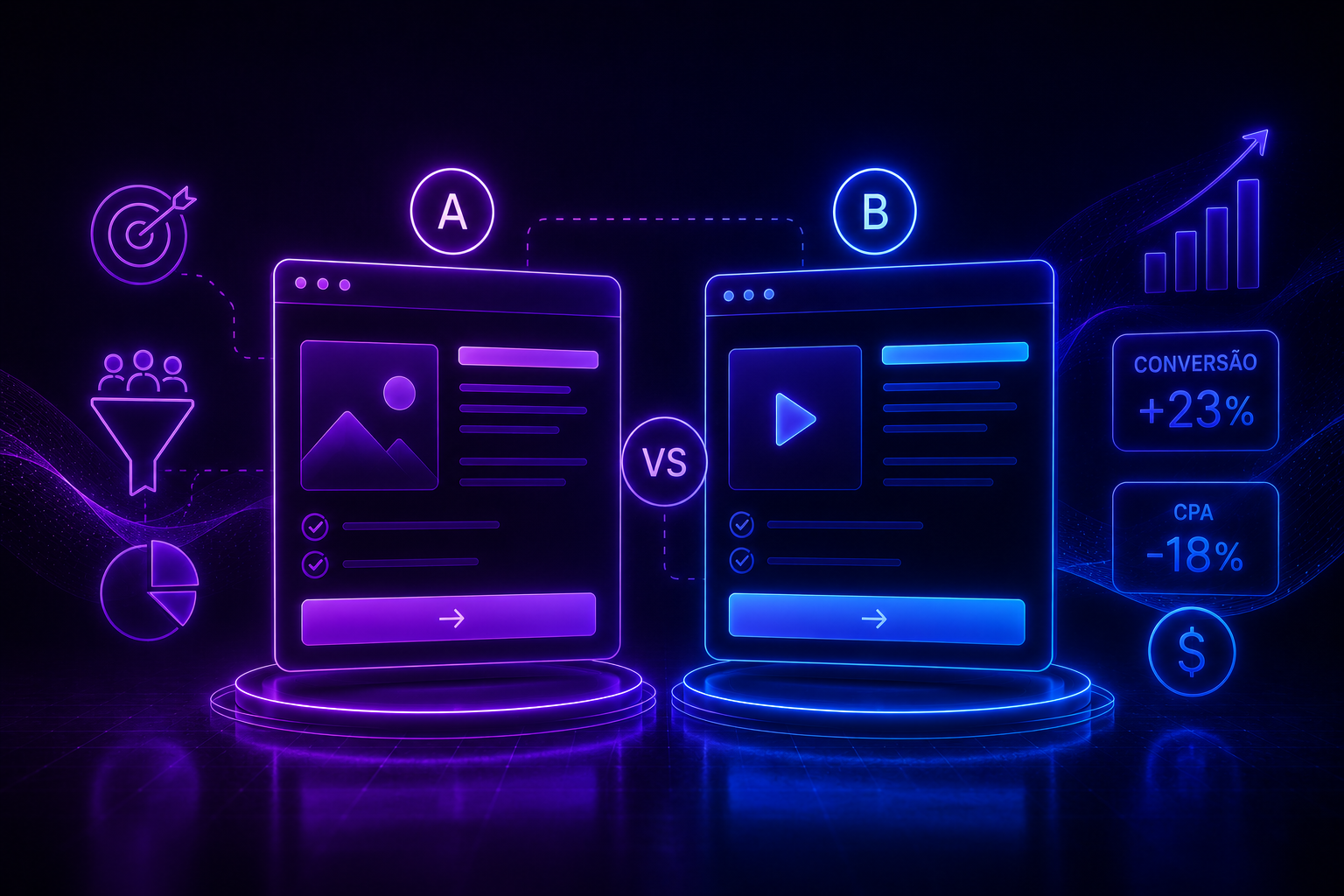
Landing page A/B testing is not swapping button colors until a winner appears. In a direct-response operation, testing reduces uncertainty about a hypothesis that can move revenue. The more expensive the traffic, the more important it is to prioritize changes that can affect conversion, CPA, and ROAS.
The best test queue starts at the bottleneck. If nobody hits play, test player, thumbnail, or promise. If they watch and do not click, review CTA and offer. If they reach checkout and do not pay, the problem is probably not the headline.
Priority 1: promise and headline
The first fold filters attention. Test a different promise, a clearer mechanism, or more specificity before style micro-tweaks. In landing page A/B testing, that opening change is often the highest-leverage copy experiment you can run.
Keep everything else as stable as possible so you know whether the change actually moved behavior.
Priority 2: offer
Price, guarantee, bonuses, payment plans, order bumps, and framing can move more revenue than visual details.
In offer tests, track AOV and net revenue, not just conversion rate. One version may sell fewer orders and produce more margin.
Priority 3: lead and VSL
When the page uses a VSL, play rate and first-minute retention show whether the problem sits before or inside the argument.
Test hook, lead, thumbnail, autoplay within browser rules, and CTA timing. Do not conclude “the VSL is too long” without looking at the retention curve.
Priority 4: proof and risk reduction
Social proof, cases, demos, and guarantees can unlock more skeptical audiences. Test the type of proof, not only its position.
Proof that answers a central objection tends to beat adding ten logos.
Read significance together with impact
A statistically reliable result that is commercially tiny may not justify permanent complexity. Consider volume, period, traffic mix, and incremental value.
Avoid ending a test out of anxiety after a few sales. Also avoid running forever when the hypothesis no longer matters to the business.
How to take this into the operation
Turn the idea into an observable hypothesis. Define which funnel stage should move, the primary metric, and the read window. Then log which copy, creative, or page version was live. That history stops the common habit of changing five things, watching results swing, and never knowing what actually happened.
It also helps to bring copy, design, and media buying closer together. The buyer sees hooks and angles that win attention. The page team sees objections and conversion drops. When those learnings land in the same swipe file, the next creative round starts from evidence, not brainstorming alone.
Metrics that should sit next to the decision
Do not stop at CTR or conversion rate in isolation. Read clicks, page interaction, CTA, checkout starts, purchases, CPA, AOV when there are add-ons, and ROAS. On video pages, add play rate, retention, and CTA exposure. That tells you whether the change bought attention, intent, or real revenue.
Conclusion
Good landing page A/B testing starts with diagnosis. Prioritize promise, offer, VSL, and proof before cosmetic details.
The final metric should talk to cash: revenue, margin, CPA, AOV, and ROAS.
Frequently asked questions
Which element should I test first?
The element tied to the biggest bottleneck. Without diagnosis, headline and offer are usually higher-value bets than button color.
Do I need a lot of traffic?
You need enough volume for reliable conclusions. Smaller operations can test bigger changes and observe longer windows.
Can I A/B test a VSL?
Yes. Hook, lead, thumbnail, CTA, and structure are valid hypotheses, always paired with play rate and retention.
Published
August 20, 2026
Categories