Launch Page Structure: From Opt-In Through Cart Close
Launch page structure maps each stage—opt-in, VSL, offer, checkout—so the sales funnel does not leak between the CPL and the cart.
Written by

Share this
Unlock exclusive Atomicat content
Beyond the blog (/blog), browse our free marketing resources and free tools for calculators and templates (/templates). If you came here searching for landing page tips or landing page best practices specifically, start with the pillars above before browsing further. Browse /resources and /tools.
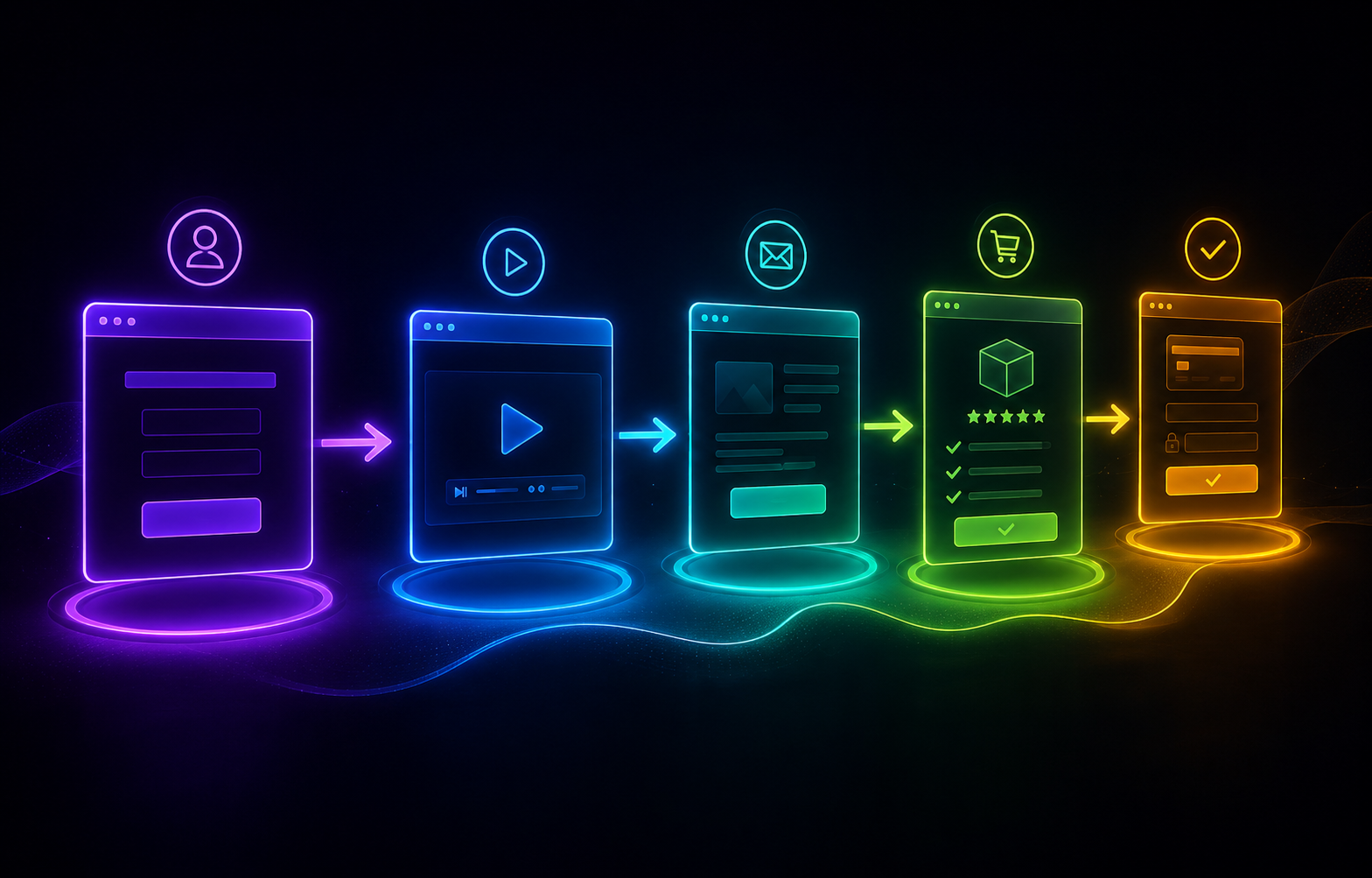
A product launch is not one sales page. It is a sequence of pages with different jobs, and each one must match the audience’s awareness stage. The opt-in page should not try to close the sale. The free training page should not fight for attention with ten CTAs. And the cart page needs to remove friction when intent is highest.
As the operation scales, the media buyer often spots the problem first: the ad delivers clicks, but rates break between opt-in, content consumption, and checkout. Mapping each page as part of the funnel shows exactly where the launch is leaking.
Capture page: sell the next step
The promise here is simple: why is it worth leaving contact details and consuming the content? Use a direct headline, few fields, and enough proof to lower risk.
Do not try to preview the entire offer. A bloated capture page can cut conversion without improving lead quality.
Free training / CPL page: focus on consumption
The job of the content page is to get play, watch time, and progression to the next piece. Strip unnecessary navigation and make the sequence obvious.
If the content is video, track play rate, retention, and completion. Those metrics say more about training quality than pageviews alone.
Warm-up between pieces of content
Not everyone consumes on the day they opt in. Email, messaging, remarketing, and replay pages bring people back.
Message match matters: if the ad hook promised a specific lesson, deliver it early in the training. Otherwise you buy attention and return frustration.
Offer page: shift from education to decision
When the cart opens, the page must organize big idea, mechanism, proof, deliverables, price, guarantee, and CTA. This is where copy answers “why now?” and “why this offer?”
On VSL offers, track lead, retention, price exposure, and checkout clicks. Do not treat every abandonment as a traffic problem.
Cart close and checkout
In the final days, speed and clarity matter. Avoid rewriting the whole offer in a rush. Use real urgency, common questions, payment options, and support.
Checkout must preserve UTMs and allow reporting by campaign and creative. Without attribution, you cannot tell which part of the launch actually paid the bill.
How to take this into the operation
Turn the idea into an observable hypothesis. Define which funnel stage should move, the primary metric, and the read window. Then log which copy, creative, or page version was live. That history stops the common habit of changing five things, watching results swing, and never knowing what actually happened.
It also helps to bring copy, design, and media buying closer together. The buyer sees hooks and angles that win attention. The page team sees objections and conversion drops. When those learnings land in the same swipe file, the next creative round starts from evidence, not brainstorming alone.
Metrics that should sit next to the decision
Do not stop at CTR or conversion rate in isolation. Read clicks, page interaction, CTA, checkout starts, purchases, CPA, AOV when there are add-ons, and ROAS. On video pages, add play rate, retention, and CTA exposure. That tells you whether the change bought attention, intent, or real revenue.
Conclusion
A healthy launch uses specialized pages and stage-level metrics. Opt-in, consumption, offer, and payment are not the same problem.
When each page has a clear job, the team can optimize the funnel without “changing everything” every time ROAS dips.
Frequently asked questions
How many pages does a launch need?
It depends on the model, but you usually need capture, content or training pages, offer, checkout, and thank-you or replay pages.
Which metric should I watch on the free training page?
Beyond visits, look at play rate, retention, completion, and progression to the next step.
Should I use the same page for every traffic source?
Not always. Message and proof can change by source, as long as the offer and measurement stay consistent.
Published
August 17, 2026
Categories