VSL Script Template: A Proven Video Sales Letter Structure (With Free Template)
Copy a complete VSL script template, see timing for every section, and learn where to place the CTA so viewers stay through the offer.
Written by

Share this
Unlock exclusive Atomicat content
Beyond the blog (/blog), browse our free marketing resources and free tools for calculators and templates (/templates). If you came here searching for landing page tips or landing page best practices specifically, start with the pillars above before browsing further. Browse /resources and /tools.
A good video sales letter can sell a product while the viewer does nothing but watch. A bad one loses them in the first 30 seconds. The difference is rarely the camera, the voice or the editing. It is the script. This guide gives you a complete VSL script template you can copy, the VSL structure behind it, how long each section should run, and exactly where to place the call-to-action button. If you have been searching for how to write a VSL that holds attention to the offer, start here.
What a video sales letter script is
A video sales letter (VSL) is a sales letter delivered as a video, usually on a page with little else on it. The video sales letter script is the word-for-word text the presenter reads or the slides display. Unlike a brand video, a VSL has one job: move the viewer from "never heard of this" to "I am buying now" in a single sitting.
That is why the VSL structure follows a strict order. Each section answers the question the viewer has at that moment: "Is this for me?", "Why should I believe you?", "How does it work?", "What do I get?", "What if it does not work?" Skip one and the viewer leaves with the question unanswered.
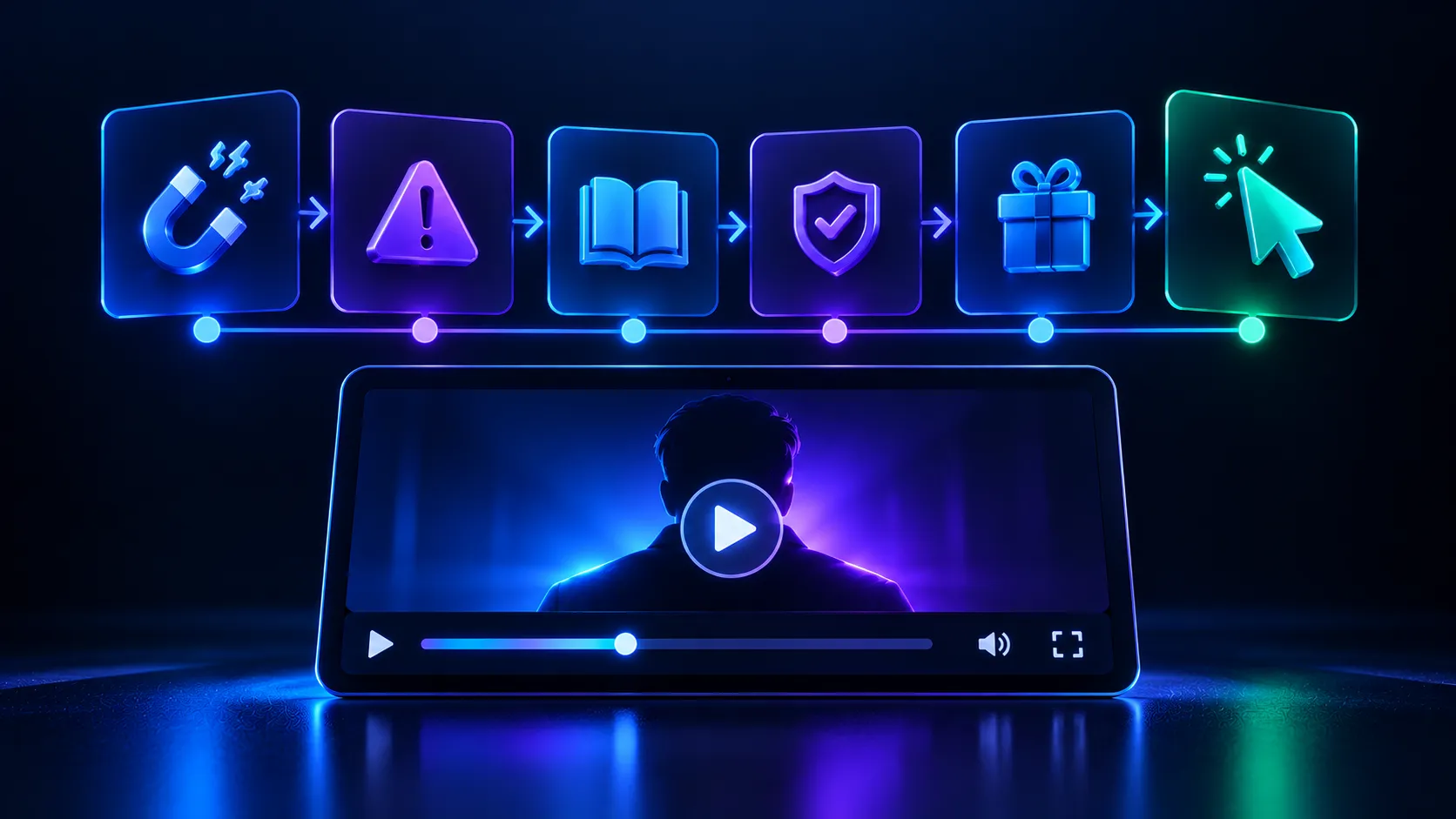
The proven VSL structure in 9 sections
The VSL script template below follows a structure that has been used, in one form or another, for decades of direct response marketing. It works for courses, coaching, supplements, software and services. Timings assume a 10 to 15 minute VSL; scale them for shorter or longer videos.
#
Section
Job
Typical length
Share of video
1
Hook
Stop the scroll, promise a specific outcome
0:00–0:30
3–5%
2
Problem
Make the viewer feel understood
0:30–2:00
10–12%
3
Agitation
Show the cost of not solving it
2:00–3:00
7–8%
4
Story / credibility
Why you, why now
3:00–5:00
15%
5
Mechanism
The new reason this works
5:00–7:00
15%
6
Proof
Results, testimonials, data
7:00–8:30
10–12%
7
Offer
What they get and the price
8:30–10:30
15%
8
Guarantee and risk reversal
Remove the fear of losing money
10:30–11:15
5%
9
Call to action and close
Tell them exactly what to do
11:15–12:00
5–8%
The VSL script template (copy and fill in)
Copy this VSL script template into a document and replace everything in square brackets. Write the way you speak: short sentences, plain words, one idea per line.
Section 1: Hook (first 30 seconds)
"If you are a [specific audience] who wants [specific outcome] without [main pain or sacrifice], this short video will show you [the new way] that [proof teaser, e.g. helped 1,200 people do X]. Stay to the end, because at minute [X] I will show you [specific curiosity point]."
Tips: name the audience in the first sentence, promise one outcome, and give a reason to keep watching. Your hook should echo the headline on your page and the ad that sent the visitor. Our guide to the sales page headline has formulas that also work as VSL hooks.
Section 2: Problem
"Let me guess. You have tried [common solution 1] and [common solution 2]. Maybe it worked for a while. But [the frustrating result] keeps coming back. You wake up thinking [inner thought the audience has]. And the worst part is [emotional cost]."
Tips: use the audience's own words from reviews, surveys and comments. The viewer should think "that is exactly me."
Section 3: Agitation
"And it is not just [surface problem]. Every month this continues, [consequence 1]. [Consequence 2]. If nothing changes, a year from now you will be [future pain]."
Tips: stay honest. Agitation should make the cost of inaction clear, not invent fears.
Section 4: Story and credibility
"I know this because I was there. [Short personal or customer story: the low point, the search, the discovery.] Since then I have [credential: results, years, clients helped]. And I want to show you what I found."
Tips: keep the story under two minutes. The story's job is to earn the right to explain the mechanism, not to tell your life history.
Section 5: Unique mechanism
"Here is what most people do not know. The reason [common solutions] fail is [root cause]. [The new way] works because it [how it solves the root cause]. It is built on [3 simple steps or principles]: [step 1], [step 2], [step 3]."
Tips: the mechanism is the heart of every strong video sales letter script. It explains why this time will be different. Name it if you can.
Section 6: Proof
"Do not just take my word for it. [Customer name] went from [before] to [after] in [time]. [Customer 2] said: '[short quote].' [Data point, e.g. 87% of students finished the program]."
Tips: use real, specific results you can verify. Show screenshots on screen while the voice-over reads them.
Section 7: Offer
"That is why I created [product name]. Inside, you get: [component 1, with benefit], [component 2, with benefit], [component 3, with benefit]. Plus, if you join today, [bonus 1] and [bonus 2]. Altogether that is worth [anchor value]. But you will not pay that. Today you can get everything for [price]."
Tips: describe each component by the outcome it creates. Anchor value should be honest and explainable.
Section 8: Guarantee
"And you are fully covered by our [X]-day [type] guarantee. Try [product]. If you do not [specific result] or you simply are not happy, email us and we will refund every cent. No questions asked."
Section 9: Call to action and close
"So here is what to do now. Click the button below this video. You will go to a secure checkout page. Enter your details, and you will get instant access to [product]. Remember, [restate the main promise]. Click the button below now, and I will see you inside."
Tips: say exactly where the button is and what happens after the click. Repeat the core promise one last time.
Short VSL script template (3-minute version)
Not every offer needs 12 minutes. For low-priced products, warm retargeting traffic or upsell pages, use this compressed VSL script template. It keeps the same VSL structure but merges sections:
- 0:00–0:15, Hook: "[Audience]: here is how to get [outcome] in [timeframe], without [pain]."
- 0:15–0:45, Problem and agitation: "Most people try [old way]. It fails because [root cause], and it costs you [consequence]."
- 0:45–1:30, Mechanism and proof: "[Product] works differently: [mechanism in one sentence]. [Customer] got [result] in [time]."
- 1:30–2:30, Offer and guarantee: "You get [components]. Today it is [price], and it is covered by our [X]-day guarantee."
- 2:30–3:00, Call to action: "Click the button below to get instant access."
In a short VSL, show the button from around 1:30, when the offer starts, because the viewer reaches the price quickly.
VSL script template examples by niche
The same VSL script template adapts to almost any market. Here is how the hook and mechanism change for three common niches:
Niche
Hook example
Mechanism angle
Strongest proof type
Online course
"How beginners land their first freelance design client in 30 days, without a portfolio"
A step-by-step system replacing trial and error
Student results with names and timeframes
Health supplement
"Why your afternoon energy crash is not about sleep"
A specific ingredient or process explained simply
Studies (cited accurately) and customer stories
B2B software
"How agencies cut reporting time from 6 hours to 20 minutes a week"
Automation of a manual task
Before/after metrics and client logos
Notice that each hook names a specific audience and a measurable outcome. That is the pattern to copy, whatever you sell.
How long should your VSL be?
There is no single right length. A good rule is to match length to price and awareness:
- Low price, warm audience (under $50): 3 to 8 minutes.
- Mid price ($50 to $500): 8 to 20 minutes.
- High price or cold audience: 20 to 45 minutes, often with more proof and a longer mechanism.
What matters more is the retention curve. If most viewers drop off before the offer, the video is too long for that audience, or the first two minutes are not doing their job. Retention analytics show you exactly where viewers leave, so you cut the right part, not the whole script.
Where to place the CTA button (button delay)
Most VSL pages hide the buy button until the video reaches the offer. This is called a button delay. It stops viewers from seeing a price before they understand the value, and it keeps the page clean while the video does the selling.
How to set it:
- Set the delay to the moment the price is revealed, not the start of the offer section. For the template above, that is around 10:00.
- Repeat the button below the video once it appears, and on mobile make sure it is visible without scrolling.
- Test the timing. Some offers convert better with the button shown at the start of the offer section, others at the price reveal. A/B test two delays and keep the winner.
- Do not hide the button for returning visitors. Someone who comes back to buy should not have to rewatch 10 minutes. Players with resume playback or cookie-based delay rules solve this.
How to write a VSL faster: a 5-step process
If you are still unsure how to write a VSL from scratch, follow this order instead of writing top to bottom:
- Write the offer first. Know exactly what is included, the price and the guarantee.
- Write the mechanism second. If you cannot explain why it works in three sentences, the VSL will not hold.
- Collect proof. Pick the three strongest, most specific results.
- Write the hook last. Once you know the mechanism and proof, the best hook is usually obvious.
- Read it aloud and time it. Cut every sentence that does not move the viewer forward. Aim for about 140 to 160 spoken words per minute.
VSL script mistakes that kill conversions
- A slow first minute. Logos, intros and "Hi, my name is" lose viewers. Start with the hook.
- No mechanism. Without a reason it works, the offer sounds like every other promise.
- Vague proof. "People love it" is not proof. Names, numbers and timeframes are.
- Feature lists in the offer. Describe outcomes, not modules.
- A weak close. Viewers need a direct instruction, not "if you are interested."
- The wrong player. If viewers can skip ahead, see related videos or the progress bar shows 40 minutes remaining, many leave early.
Recording and hosting your VSL
The script is the hardest part, but the player decides whether people actually watch it. YouTube shows recommendations and branding that pull viewers away. A player built for sales pages keeps attention on your offer.
AtomicPlayer is built for sales funnels and VSLs. Magic Autoplay starts the video automatically and supports resume playback, so returning viewers pick up where they left off. Mini Hooks add short messages during playback to drive clicks, dynamic in-video CTAs let you show buttons at exact moments, and retention heatmaps show where viewers drop off so you know which part of the VSL script template to rewrite. You can also A/B test hooks and CTAs, then build the page around the video in AtomicBuilder. For the page itself, see our guide on how to create a sales page.
Conclusion
A high-converting VSL is not a mystery. It is a sequence: hook, problem, agitation, story, mechanism, proof, offer, guarantee, close. Use the VSL script template above, time each section, put the button where the price appears and let retention data tell you what to rewrite. Write it, record it, measure it, and improve one section at a time.
Frequently asked questions
Can I use the same VSL script for ads and for the sales page?
Not as-is. A VSL on a sales page can run 10 minutes or more because the viewer has already clicked. An ad needs a 15 to 60 second version built from your hook, one proof point and a call to click. Cut the ad from the full script so the message stays consistent.
Should I show my face in a VSL or use slides?
Both work. Text-on-screen slides with a voice-over are fast to produce and easy to update, which suits testing. A face-to-camera VSL builds trust faster for coaching, services and personal brands. Many sellers test both versions of the same script.
How often should I update my VSL script?
Review it whenever retention data shows a clear drop-off, when the offer changes, or when ad performance falls. Updating one section, such as the hook or the proof, is usually enough. You rarely need to rewrite the whole script.
Can AI write a video sales letter script for me?
AI can draft each section quickly if you give it your audience, mechanism, proof and offer. It cannot invent real proof or know your customers' exact words, so treat the draft as a starting point and rewrite it in your voice with verified results.
What is the difference between a VSL and a webinar?
A VSL is short and pre-recorded, with one continuous pitch and a buy button. A webinar is longer, often live or simulated live, and teaches more before the offer. VSLs suit lower-priced and impulse offers, while webinars often work better for high-ticket products that need more trust.
Published
October 21, 2026
Categories
Related Articles
Discover more insights and strategies to grow your business.