Sales Funnel Stages: The Five Steps You Must Measure Before You Scale
The five sales funnel stages — awareness, interest, desire, action, retention — and how to measure each one before you raise paid spend.
Written by

Share this
Unlock exclusive Atomicat content
Beyond the blog (/blog), browse our free marketing resources and free tools for calculators and templates (/templates). If you came here searching for landing page tips or landing page best practices specifically, start with the pillars above before browsing further. Browse /resources and /tools.
A sales funnel is the ordered path a stranger follows until they become a customer, and its five stages (awareness, interest, desire, action, and retention) decide whether your paid traffic scales or burns. The point is not to draw a pretty funnel, but to know what each stage must achieve, measure conversion from one to the next, and repair the weakest link before you raise spend. This guide explains the five stages, how to diagnose them, and how to build them in a single funnel builder.
The question that governs every stage is always the same: what is the next action, and what is holding it back? Answering that stage by stage is, in practice, your entire funnel strategy.
What a sales funnel is and why it is measured by stages
A sales funnel is the sequence of steps that takes a person from discovering you to buying and coming back. A digital sales funnel turns each step into a concrete page you can measure, which lets you see exactly where you win people and where you lose them.
To put this into practice, explore sales funnel builder in Atomicat.
Measuring it by stages is what makes it actionable: instead of looking at a single overall conversion rate, you watch the percentage that moves from one stage to the next and spot the exact point where the journey drops off.
The five sales funnel stages
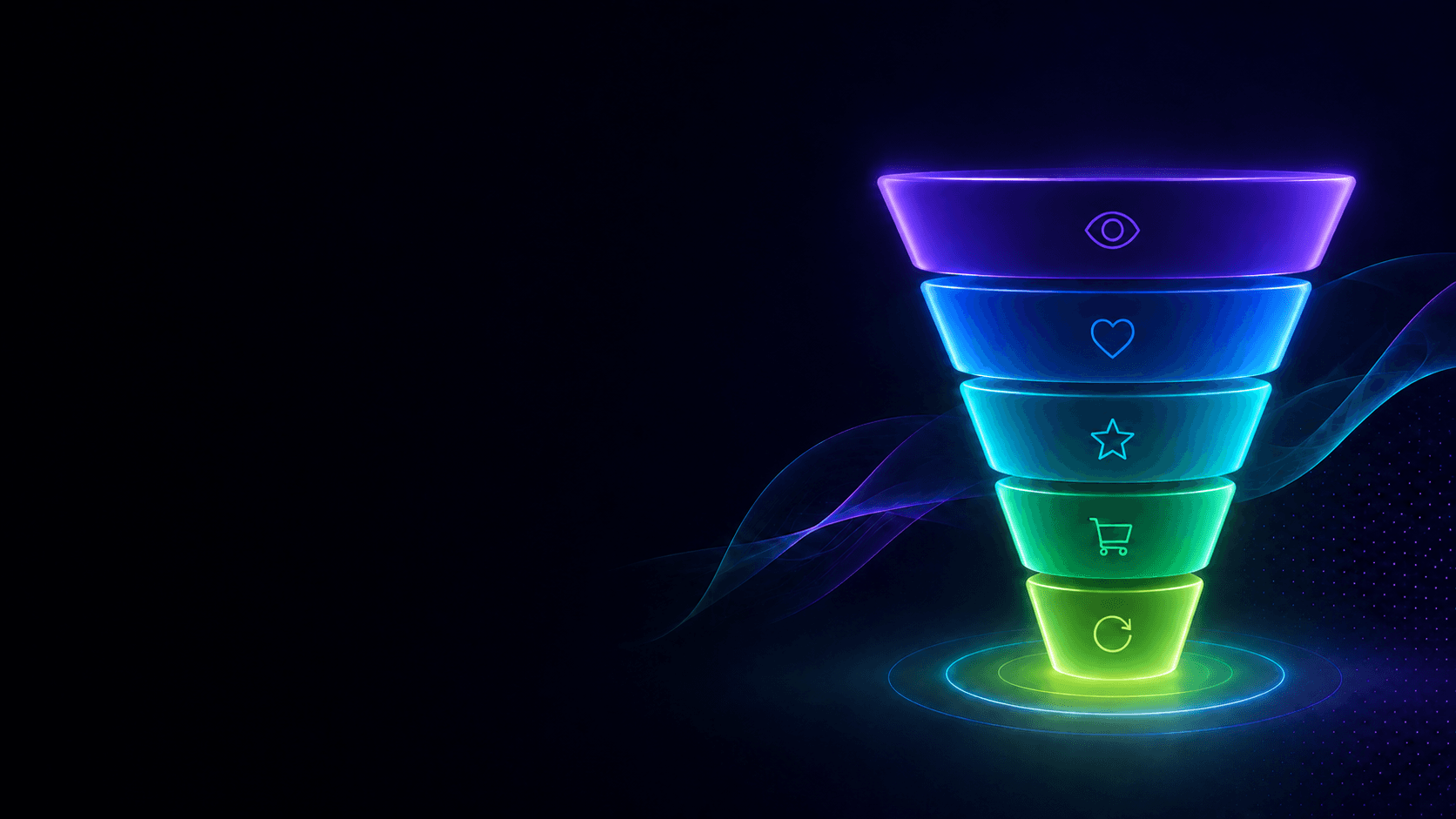
Five stages cover virtually any digital sales funnel:
Awareness: the widest stage. You get the right audience to discover you with ads and presell pages. Metric: qualified clicks.
Interest: you turn attention into a small commitment, usually capturing the lead. Metric: opt-in rate. This is where a fragile funnel loses people.
Desire: you build belief with your sales page or your webinar. Metric: depth of engagement. It is the most underestimated stage.
Action: the purchase. Checkout cannot fail, because these wins are almost pure margin. Metric: purchase completion rate.
Retention: you keep the customer with upsells, renewals, and solid delivery. Metric: repurchase rate. This is what turns a campaign into a business.
Why the funnel breaks when you scale
A funnel that works at low spend can fail when you scale, because the weakest stage sets the ceiling for the whole system. When you raise the budget, colder traffic comes in and exposes shallow stages that used to go unnoticed.
Attribution also gets murkier at volume. That is why you need clean tracking at every stage: it is not the prettiest stage that sets what you can bill, but the weakest one. A good funnel strategy is, in essence, sequential debugging: you fix the worst step, measure again, and move to the next.
How to diagnose your funnel step by step
Diagnose with numbers, one at a time:
Write down the conversion rate between each pair of stages in your funnel.
Find the stage that is furthest from its reasonable benchmark.
Fix only that stage and measure again before you touch anything else.
The temptation is to redesign everything at once. Do not: fix the worst link, then the next, and let the funnel improve in a measurable way, stage by stage.
How to map each stage to a funnel builder
Each stage maps to a concrete piece you can assemble in a funnel builder:
Awareness: ads and presell or advertorial pages.
Interest: landing pages and quiz funnels to capture and qualify the lead.
Desire: the sales page or the webinar.
Action: checkout.
Retention: upsells, subscriptions, and billing.
When the same builder owns every stage, the funnel talks to itself and you get reliable attribution from start to finish. With Atomicat you can build from the presell page through checkout in one place, which simplifies both assembly and measurement.
The conclusion
A funnel strategy is not a prettier diagram: it is knowing what each stage must do, measuring conversion between them, and repairing the weakest one before you scale. Awareness, interest, desire, action, and retention: build all five, measure all five, and your funnel will hold when you put investment weight on it.
Frequently asked questions
How many stages does a sales funnel have?
Five stages cover any digital sales funnel: awareness, interest, desire, action, and retention. Some models subdivide them further, but these five are enough to diagnose and optimize most funnels.
What is a digital sales funnel?
It is a sales funnel built on measurable web pages: each stage is a page (presell, landing, sales page, checkout, upsell) with its own metric. That lets you see conversion between stages and find the exact point where people drop off.
Which funnel stage should I fix first?
The one furthest from its benchmark. Measure conversion between each pair of stages, identify the weakest link, and fix it before you touch the rest; then repeat the process with the next one.
Why does my funnel work at low spend but not when I scale?
Because scale attracts colder traffic that exposes the weakest stage, and that stage sets the ceiling for the whole system. To scale you need to reinforce the steps that lose people at volume and have clean tracking at every stage.
What is a sales funnel for?
It is for turning strangers into customers in a systematic, measurable way: instead of depending on a single page, you spread the persuasion work across stages you can optimize one by one to lower acquisition cost and raise value per customer.
Published
August 10, 2026
Categories