How to Write Landing Page Copy That Converts
Learn how to write landing page copy that converts: a clear value proposition, benefits over features, strong headlines, and calls to action, plus a simple process.
Written by

Share this
Unlock exclusive Atomicat content
Beyond the blog (/blog), browse our free marketing resources and free tools for calculators and templates (/templates). If you came here searching for landing page tips or landing page best practices specifically, start with the pillars above before browsing further. Browse /resources and /tools.
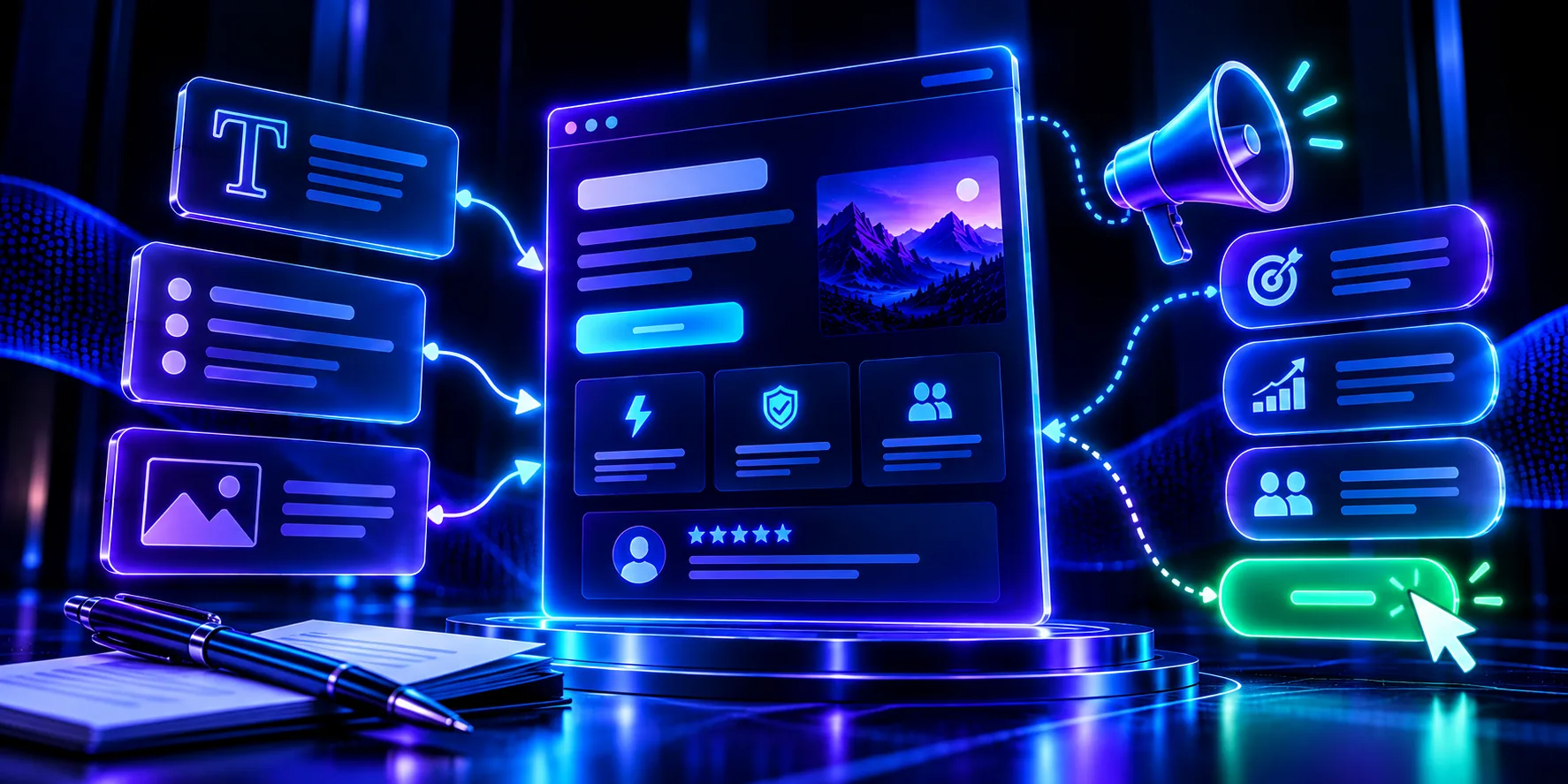
Landing page copy is the text that persuades a visitor to act. Good copy is clear, focused on the reader, and built around one goal. It explains what you offer, who it is for, and why it matters, then asks for a single action in words the visitor understands.
This guide covers how to write landing page copy that converts, from the value proposition to the call to action, plus a simple process you can follow every time. You do not need to be a professional copywriter. You need a clear message and a few reliable habits.
What makes landing page copy convert?
Copy converts when it speaks to the reader's goal, not the writer's ego. Every strong landing page answers three questions fast: what is this, is it for me, and what do I do next.
The pages that convert keep the answers simple. They lead with the benefit the visitor cares about, back it with proof, and remove anything that does not push toward the one action. Clever wording is far less important than clarity. If a visitor has to work to understand your offer, most will not bother, however polished the sentences sound.
The best copy also starts with research, not writing. Before you draft a line, learn how your customers actually talk about their problem. Read their reviews, their support emails, and the questions they ask, and note the exact words they use. When your copy echoes those words back, the page feels like it was written for that reader, because in a sense it was. Copy built from real customer language almost always beats copy invented at a desk, because it meets people where they already are instead of asking them to learn your terms.
How do you write a strong value proposition?
Your value proposition is the heart of the page. It tells visitors what they get, who it is for, and why it beats the alternatives, ideally within the first five seconds in your hero section.
Keep it plain and specific. Name the outcome the visitor wants and how you deliver it, without jargon or vague claims. A line like "Build landing pages that convert, no code needed" works because it names the result and the audience in a breath. Compare that to "Innovative solutions for modern businesses," which says nothing a reader can picture.
Write your value proposition first, since it anchors everything else on the page. Once it is clear, the rest of the copy has a job to support.
Why should you write benefits, not just features?
This is the habit that most improves weak copy. A feature describes your product, while a benefit explains why the reader should care.
Features tell people what something is. Benefits tell them how their situation improves. "Drag-and-drop editor" is a feature. "Build a page yourself in an afternoon, without waiting on a developer" is the benefit that feature delivers. Readers rarely act on features alone, because they have to translate the feature into a benefit themselves, and many will not.
The fix is simple. For each feature you want to mention, ask "so what?" until you reach the real payoff for the reader, then lead with that payoff and mention the feature as support.
That does not mean you should hide your features. Buyers often want to confirm the specifics before they act, so features still belong on the page. The order is what matters. Open with the benefit that makes someone care, then list the feature that delivers it as proof that the benefit is real. "Publish in minutes with a drag-and-drop editor" leads with the payoff and backs it with the feature in one line. Pairing the two this way persuades the reader and reassures them at the same time.
How do you write headlines and subheadings?
Your headline carries most of the weight, since it is the first and sometimes only thing a visitor reads. It should state your main benefit clearly enough that someone understands the offer at a glance.
Focus the headline on the end result, and match its wording to the ad or link that brought the visitor in, so the page feels like a continuation rather than a surprise. Use a subheading to add the detail the headline leaves out, such as how it works or who it is for. Keep both short enough to read in one pass. Our note on writing a strong sales page headline goes deeper if headlines are where you tend to get stuck.
Then use descriptive subheadings down the page so a visitor who only scans still absorbs your message. Many people read the headings and little else, so make them carry the story.
A simple way to test this is to read only your headings, top to bottom, and see whether they tell a coherent story on their own. If they do, a scanner gets your message even without reading the body. If they are vague labels like "Features" and "Details," they carry nothing, and the scanner leaves with no reason to act. Turning flat labels into short, benefit-led lines is one of the quickest upgrades you can make to a page, because it reaches the large share of visitors who never read a full paragraph.
How do you write a call to action that gets clicks?
The call to action is where copy turns into conversion. It should be clear, visible, and written from the reader's point of view.
Skip flat button text like "Submit" or "Learn more." Use action words that describe the value, such as "Start my free trial" or "Get my free template," so the reader knows exactly what happens next. Keep one primary action per page so nothing competes with it, and repeat that action as the page gets longer, so people can act the moment they feel convinced. Small wording changes here often move results, which makes the call to action a smart thing to test.
How does proof strengthen your copy?
Words alone only go so far. Visitors trust evidence more than promises, so proof is part of your copy, not a decoration.
Add specific testimonials with real names and results, since a concrete quote convinces far more than a generic one. Include review scores, recognizable logos, or a short case study where they fit. Numbers help too, as long as they are real, so never invent statistics to fill a gap. The point is to show that other people already trust you, which lowers the risk a visitor feels before acting. Our guide on social proof covers the formats that work best.
Place your proof where doubt tends to appear, not just in one block at the bottom. A testimonial right beside your main claim backs it up at the exact moment a reader might question it. A reassuring line near the button, such as a short guarantee or a note that no card is needed, eases the last hesitation before the click. Proof works hardest when it answers a worry the instant a reader feels it, so scatter it thoughtfully across the page rather than saving it all for the end.
What is a simple process for writing landing page copy?
You do not have to start from a blank page every time. A repeatable process keeps your copy focused and fast to write.
First, define your one goal and the audience you are writing for, and note their real language, needs, and worries. Second, draft your value proposition and headline around the benefit that matters most to them. Third, write the body in short, scannable chunks, leading with benefits and supporting them with features and proof. Fourth, write a clear call to action and place it where a convinced reader can act. Finally, cut anything that does not serve the goal, since a tighter page usually converts better than a longer one.
Once the copy is live, test it. Change one element, such as the headline or the call to action, and compare results, as our guide on A/B testing explains. The pieces here also line up with what makes a good landing page, so the copy and the layout reinforce each other.
One last habit sharpens almost any draft: read it aloud. Your ear catches what your eye misses. Sentences that felt fine on the screen turn out to be too long to say in one breath, and phrases that sounded clever suddenly sound stiff. If you stumble reading a line, a visitor will stumble too. Cut it, split it, or simplify it until the whole page sounds like a person talking to another person. Copy that reads naturally out loud is copy that converts, because it feels human rather than written.
Frequently asked questions
What is landing page copywriting?
It is writing the persuasive text on a landing page that guides a visitor toward one specific action, such as signing up or buying.
How long should landing page copy be?
As long as it needs to make the case and no longer. Simple offers may need a screen, while considered purchases may need more proof and detail.
What is the difference between features and benefits?
A feature is what your product has or does. A benefit is how that feature improves the reader's situation. Copy that leads with benefits converts better.
Do I need to be a professional copywriter?
No. A clear message, a focus on the reader's benefit, and a simple process will produce copy that converts without professional training.
How do I know if my copy is working?
Track your conversion rate and test one change at a time. Compare the versions so you keep the wording that actually performs better.
Write copy that turns clicks into customers
Strong landing page copy is clear, reader-focused, and built around one action. Lead with benefits, back them with proof, and ask plainly for the click.
Start your free trial of Atomicat and put your new copy on a page built to convert, no code required.
Published
September 4, 2026
Categories